

Ireland
Rock of Cashel
Journey to the land of saints, scholars, and martyrs on this spiritually rich pilgrimage to Ireland, where breathtaking landscapes and deep Catholic faith are inseparably woven together. From the streets of Dublin—marked by Marian devotion, ancient cathedrals, and the perseverance of the faithful through persecution—to the quiet monastic valleys of Glendalough and the dramatic heights of the Rock of Cashel, this pilgrimage traces the living story of Irish Christianity. Pilgrims encounter the legacy of Ireland’s great saints—St. Patrick, St. Brigid, St. Kevin, and St. Oliver Plunkett—at places where their witness continues to inspire prayer, conversion, and missionary zeal. The journey moves through the rugged beauty of the west, from Croagh Patrick and the Cliffs of Moher to the remote early Christian sites of Kerry and the Dingle Peninsula, where monks once sought God at the edge of the known world. Time at Knock Shrine, one of the world’s principal Marian sanctuaries, offers a powerful encounter with Our Lady’s quiet message of hope, while visits to Lough Derg, Armagh, and Downpatrick immerse pilgrims in Ireland’s penitential traditions and apostolic foundations. Blending sacred worship, stunning natural beauty, authentic Irish culture, and moments of shared fellowship, this pilgrimage invites travelers not only to see Ireland, but to encounter its enduring faith—and to return home renewed in prayer, strengthened in hope, and inspired to live the Gospel more deeply.
Your trip includes
-
Round-trip airfare from Dulles International Airport
-
Motorcoach transportation from your parish to Dulles (IAD) and back.
-
All airport taxes and fuel surcharges
-
First Class Hotel Accommodations:
-
1 night: Dublin, Ireland
-
1 night: Tipperary, Ireland
-
1 night: Killarney, Ireland
-
1 night: Limerick, Ireland
-
1 night: Galway, Ireland
-
1 night: Knock, Ireland
-
1 night: Armagh, Northern Ireland
-
2 nights: Dublin, Ireland
-
-
Single supplements, while available
-
Transfers as per itinerary
-
Breakfast and dinner daily
-
Wine and mineral water with dinners
-
Transportation by air-conditioned motor coach
-
Tour escort throughout
-
Assistance of professional local Catholic guide(s) as appropriate
-
Sightseeing and admission fees as per Itinerary
-
Mass daily and spiritual activities
Not included:
-
Lunches and beverages not mentioned
-
Travel Insurance
-
Tips to your guide & driver. (est. $100 total)
-
Church donations (budget $2.00-$5.00 per Mass)
-
Passports, visas, and any required travel documentation

Itinerary

Dulles International Airport
Day 1
After a pilgrimage Mass at your parish, transfer by coach bus to Dulles International Airport to catch an evening flight for arrival in Dublin, Ireland.
Day 2
Arriving early in Dublin, the pilgrimage begins on foot with a short but deeply meaningful walking tour through the spiritual heart of the city. Pilgrims first gather at the Blessed Virgin Mary Statue on Merrion Square, pausing in prayer before Our Lady and reflecting on the resilience of Irish Catholics during the years of the Penal Laws, when public expressions of the faith were suppressed yet devotion endured. Continuing toward the city center, the group visits Whitefriar Street Church, home to the relics of St. Valentine, and St. Teresa’s Carmelite Church, where time is set aside for quiet prayer shaped by Carmelite spirituality, emphasizing interior silence, trust in God, and fidelity to Christ even amid hardship.
The pilgrimage culminates at St. Mary’s Pro-Cathedral, the mother church of the Archdiocese of Dublin and a powerful symbol of Catholic perseverance in a city long without a formal cathedral. Here, pilgrims gather around the Eucharist for Mass, giving thanks for Ireland’s enduring faith and its extraordinary missionary legacy that has carried the Gospel across the world. The day concludes with a festive evening in a traditional Dublin pub, enjoying local music —an opportunity to experience Ireland’s living culture and hospitality—before transferring to the hotel for a dinner and a well-earned rest after a spiritually rich first day on pilgrimage.

Dublin, Ireland
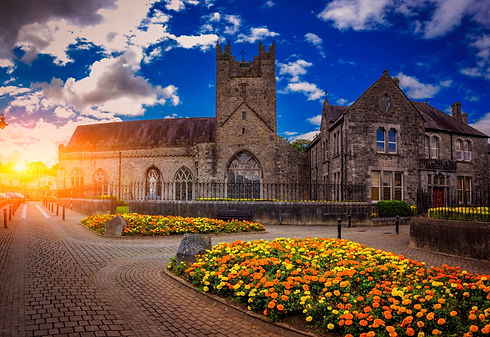
The Black Abbey, Kilkenny
Day 3
Today’s pilgrimage leads through the rolling mountains of Wicklow, often called the “Garden of Ireland,” offering a landscape that naturally invites contemplation and prayer. The journey brings us to Glendalough, the renowned monastic city founded in the 6th century by St. Kevin in the serene “valley of the two lakes.” Once a major center of learning, ascetic life, and pilgrimage, Glendalough reflects the heart of early Irish monasticism, where faith, study, and harmony with creation were deeply intertwined. During a guided visit, pilgrims encounter the iconic round tower, the ruins of St. Peter and St. Paul’s Cathedral, and St. Kevin’s Church, quietly set within an ancient cemetery. The legends surrounding St. Kevin—often likened to St. Francis of Assisi for his closeness to nature—invite reflection on holiness expressed through simplicity, prayer, and trust in God.
Continuing south, the pilgrimage travels to Kilkenny, one of Ireland’s most important medieval Catholic centers. Here, visits include St. Canice’s Cathedral and its striking round tower, a testament to the continuity of Christian worship on this site for over a millennium. Pilgrims also stop at Black Abbey, founded by Dominican friars and renowned for its luminous stained glass and tradition of preaching, as well as St. Mary’s Cathedral, reflecting the richness of Ireland’s ecclesial heritage. The day concludes in Tipperary with dinner and overnight, allowing time to rest and reflect on the profound witness of Ireland’s saints, scholars, and monastic communities who shaped the faith of a nation and beyond.
Day 4
Today’s pilgrimage brings us to one of Ireland’s most iconic and sacred sites, the Rock of Cashel, dramatically rising above the surrounding countryside. Once the seat of the Kings of Munster, this historic complex became a powerful symbol of the Church’s authority in medieval Ireland. Pilgrims tour the great Cathedral, the ancient Round Tower, and the exquisitely preserved Cormac’s Chapel, renowned for its Romanesque architecture and biblical carvings. A visit to the on-site museum allows pilgrims to view the original St. Patrick’s Cross, deepening reflection on Ireland’s apostolic roots and the enduring legacy of St. Patrick, whose mission shaped the spiritual identity of the nation.
From Cashel, the pilgrimage continues to the peaceful surroundings of Mount Melleray Abbey, a Trappist (Cistercian) monastery founded in the 19th century. Set amid rolling hills, the abbey offers a striking contrast to the grandeur of Cashel, inviting pilgrims into a quieter encounter with God marked by silence, prayer, and simplicity. Here, the monastic witness reflects the heart of contemplative Catholic life—rooted in the Liturgy of the Hours, work, and hospitality. The day concludes with a transfer to Killarney for dinner and overnight, providing time to rest and reflect on the balance of Ireland’s rich ecclesial history and its living traditions of prayer and monastic devotion.

The Rock of Cashel

MacGillycuddy's Reeks
Day 5
Today’s pilgrimage unfolds amid some of Ireland’s most awe-inspiring landscapes, where natural beauty and early Christian faith are inseparably linked. Traveling through the dramatic MacGillycuddy’s Reeks and the lakes and forests of Killarney National Park, pilgrims cross the Blackwater Bridge and continue to the colorful village of Sneem. The journey proceeds to Cahersiveen, with a pause to view the evocative ruins of Ballycarbery Castle, a reminder of Ireland’s layered history of faith and struggle. Crossing the Valentia Island Bridge, pilgrims arrive at St. Finan’s Bay, where sweeping views of Skellig Michael call to mind the radical witness of early monks who sought God in silence and sacrifice at the very edge of the known world.
In the afternoon, the pilgrimage continues onto the Dingle Peninsula, a region renowned for its concentration of early Christian sites. Pilgrims visit the beautifully preserved Gallarus Oratory, an extraordinary stone chapel that has endured for over a millennium as a testament to the devotion of Ireland’s first Christians. From Eagle Mount and the cliffs of Slea Head, expansive Atlantic views inspire reflection on God’s grandeur and the courage of those who evangelized these remote shores. The day concludes with quiet prayer at the ancient Kilmalkedar Church, grounding the pilgrimage in worship before transferring to Limerick for dinner and overnight, enriched by a day that reveals how faith took root in even the most rugged corners of Ireland.
Day 6
The day begins in Limerick with a visit to St. Mary’s Cathedral, one of Ireland’s oldest continuously used cathedrals and a powerful witness to the endurance of Catholic worship through centuries of change. Founded in the 12th century on the site of an earlier royal palace, the cathedral’s soaring stone architecture and rich liturgical heritage invite pilgrims to reflect on the deep roots of faith in Ireland’s urban centers. From here, the pilgrimage continues into County Clare, where the journey turns contemplative as pilgrims encounter the awe-inspiring Cliffs of Moher. Rising nearly 390 feet above the Atlantic Ocean, these dramatic cliffs stir a sense of humility before God’s creation, echoing the Celtic Christian tradition of encountering the Creator through the beauty and power of the natural world.
Traveling northward along the coast, the route follows the shores of Galway Bay, where rugged stone landscapes meet deep blue waters, offering moments for quiet reflection along the way. Arriving in the lively city of Galway—long known for its steadfast Catholic identity and medieval character—pilgrims visit Galway Cathedral, dedicated to Our Lady Assumed into Heaven and St. Nicholas. This modern cathedral, built in the 20th century, symbolizes the continuity of faith from Ireland’s ancient past into the present day. The evening concludes with dinner and overnight in Galway, allowing pilgrims to experience the warmth, music, and hospitality of a city where Catholic tradition and Irish culture continue to thrive side by side.

Cliffs of Moher

Kylemore Abbey
Day 7
Departing Galway, today’s pilgrimage journeys through the spiritual heart of the west of Ireland, beginning at the breathtaking Kylemore Abbey. Nestled beneath the Twelve Bens, this Benedictine monastery and Neo-Gothic church offer a serene setting for prayer and reflection, recalling the monastic tradition that has shaped Irish faith for centuries. The pilgrimage then continues to Croagh Patrick, Ireland’s most sacred mountain, traditionally associated with St. Patrick. For over 1,500 years, pilgrims have climbed—or prayed at the base of—this mountain in penance and devotion, recalling St. Patrick’s forty-day fast and the call to conversion at the heart of the Christian life.
The day continues at Ballintubber Abbey, a remarkable 13th-century church known as “the Abbey that refused to die,” where Mass has been celebrated almost continuously for more than 700 years despite persecution and hardship. From there, the pilgrimage reaches its Marian climax at Knock Shrine, one of the world’s principal Marian shrines. Here, pilgrims tour the Apparition Chapel, commemorating the 1879 apparition of the Blessed Virgin Mary, St. Joseph, and St. John the Evangelist, and visit the Basilica of Our Lady, Queen of Ireland, a place of profound prayer, healing, and hope. After checking into the hotel, the day concludes with dinner, allowing time to reflect on Ireland’s deep Marian devotion and the enduring faith that continues to draw pilgrims from around the world.
Day 8
Today’s pilgrimage invites a profound encounter with prayer, penance, and the roots of Irish Christianity, beginning at Lough Derg, the sacred island sanctuary associated with St. Patrick. For centuries, Lough Derg—often called St. Patrick’s Purgatory—has been one of Ireland’s most intense and revered pilgrimage sites, drawing the faithful into a deeply penitential tradition of fasting, prayer, and vigil. Even for those not undertaking the full penitential pilgrimage, the island’s stark simplicity powerfully recalls the call to conversion, perseverance, and trust in God that marked St. Patrick’s own missionary life and continues to inspire Irish Catholic spirituality.
The journey then continues to Armagh, the historic ecclesial heart of Ireland and the seat of St. Patrick himself. Armagh is unique in housing two cathedrals dedicated to the nation’s patron saint, reflecting the complex religious history of the island. Pilgrims visit St. Patrick’s Cathedral, the mother church of the Catholic Archdiocese of Armagh, dramatically situated on a hill overlooking the city. Here, surrounded by the symbols of apostolic faith and continuity, pilgrims reflect on Ireland’s enduring Christian identity, its trials and divisions, and its lasting mission to proclaim the Gospel—rooted in the faith first preached by St. Patrick and carried forward through centuries of steadfast witness.

Lough Derg

Day 9
Today’s pilgrimage traces the footsteps of Ireland’s greatest saints, beginning in Downpatrick, where pilgrims visit Down Cathedral. According to ancient tradition, this sacred site marks the burial place of St. Patrick, alongside St. Brigid and St. Columba. Standing at Patrick’s grave offers a powerful moment of prayer and gratitude for the saint whose missionary zeal brought Christianity to Ireland and laid the foundations for a faith that would endure persecution, flourish in monastic learning, and spread throughout the world.
The pilgrimage continues south to the Dundalk area with a visit to St. Brigid’s Church, honoring St. Brigid, one of Ireland’s most beloved saints and a model of charity, leadership, and holiness. From there, the journey proceeds to Drogheda to visit St. Peter’s Church, home to the revered relic of St. Oliver Plunkett, Ireland’s great martyr of the Penal Laws. This final stop invites reflection on fidelity to Christ amid suffering and persecution before returning to Dublin, bringing the pilgrimage full circle—rooted in the witness of Ireland’s saints and strengthened by their enduring example of faith.
Day 10
The day begins in Kildare with a visit to St. Brigid’s Cathedral & Round Tower, a site deeply associated with St. Brigid, one of Ireland’s three patron saints. Kildare was one of the most important centers of early Irish Christianity, founded by St. Brigid herself, whose witness of prayer, charity, and leadership shaped the spiritual life of the nation. The soaring round tower and cathedral grounds invite pilgrims to reflect on Ireland’s monastic roots and on St. Brigid’s enduring legacy of holiness, hospitality, and service to the poor—values that continue to animate Irish Catholic life today.
Returning to Dublin, the pilgrimage visits two of the city’s most historic churches: St. Patrick’s Cathedral and Christ Church Cathedral. Though both now belong to the Church of Ireland, they stand on sites that were once central to medieval Catholic worship and remain powerful symbols of Ireland’s Christian heritage and the complex history of faith on the island. Walking through these great cathedrals offers an opportunity to reflect on unity, continuity, and renewal within the Church. The day concludes with free time in Dublin’s lively Temple Bar, followed by dinner, blending prayerful reflection with the warmth, culture, and hospitality of Ireland’s capital city.


Day 11
The pilgrimage concludes with a late morning flight from Dublin to Washington Dulles International Airport, as pilgrims carry home the spiritual fruits of the journey. Upon arrival, a private motorcoach returns the group to the starting parish, allowing time for reflection on the sacred sites, saints, and enduring faith of Ireland, and on how the graces received on pilgrimage can continue to shape daily life.
AMDG Travel Disclaimer
From time to time, local religious or national holidays, weather, traffic conditions, or other unforeseen circumstances may require adjustments to the sequence of activities or result in the omission of certain sites or events. While every effort will be made to operate the itinerary as planned, the itinerary should be understood as an indication of the planned schedule rather than a binding guarantee of specific stops or events. Hotels listed on the itinerary have been carefully selected and contracted in advance for this pilgrimage. However, due to availability changes, operational requirements, or circumstances beyond our control, it may occasionally be necessary to substitute a hotel. In such cases, AMDG Travel will secure accommodations of equivalent or higher quality, consistent with the overall standard, location, and character of the pilgrimage.


